

Administration Services in Japan - Outsourcing by HTM
HTM Administration Services include
Our Administration Services, outsourced from Tokyo and covering all Japan, provide assistance in business establishment, facilities management, legal affairs, regulatory filings, business consulting, general planning, and setting up and maintaining policies and procedures for your Japan business.
Business Establishment
Business Establishment begins with the translation of your office setup ideas into a realistic plan. We can help you determine the best entity type, and share our experience on setting up companies in Japan. HTM will also perform the required registrations, document filings, and other procedures.
Facilities Management
Facilities Management, including locating and setting up a new office, or maintaining an existing one, is handled by our General Administration Services.
Legal Affairs
Legal Affairs including company establishment, statutory filings, contracts, licensing agreements, and shareholders' and board minutes are managed by our General Administration Service, using our retained attorneys.
Regulatory Filings
Regulatory Filings are a requirement, and can have a significant impact on your Japan business. The subjects include accounting methods, payroll, human resources, legal, and taxation. HTM can manage these filings for your business.
Business Consulting
Business Consulting services are available to help you run your Japanese business efficiently, and in conformance with local practice. HTM can also show you how to make the most out of the services and reports available from our systems, so that the information translates into the kind of business intelligence that makes a difference.
Business Planning & Analysis
Business Planning & Analysis services include budget & variance analysis, cash flow management, and other types of reporting that you would expect from a financial management organization.
Policies & Procedures
Policies & Procedures, along with relevant facts, schedules, and operating information, are maintained in HTM's databases. This information is organized into an hierarchical framework that provides for logical categorization and ease of use. This information is accessible to you online.
Administration Reporting
The administration section of the Business Information Portal (BIP) provides two administration references: an Approval Requirements list and a calendar of Japanese National Holidays.
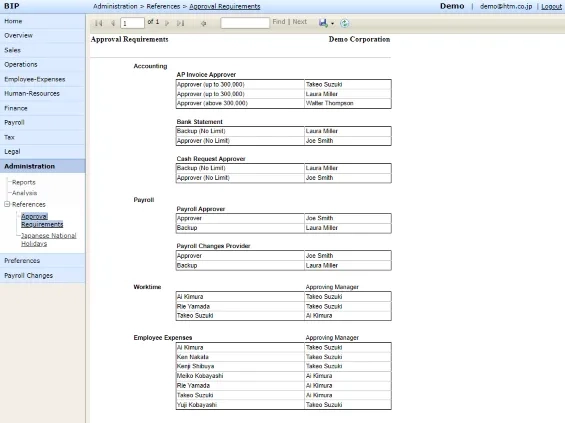
Approval Requirements
The Approval Requirements is a reference that lists who can approve what within the company. Each employee's approving manager is listed as well as the approver level and permissions and the backup approvers.
Japanese Holidays Calendar
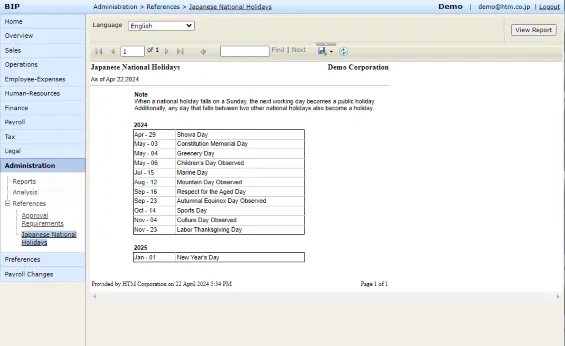
The upcoming Japanese National Holidays in the next 13 months are listed here.
HTM Business Start Points
HTM’s Business Start service provides a comprehensive service for starting a business in Japan, whether to set up a representative office, open a branch office, or establish a company. To start a business in Japan is not difficult. However, each of type of business entity has advantages and disadvantages affected by cost, and legal, tax, and banking regulations, as well as practices accepted by employees, customers and vendors—all these factors require careful consideration.
Why set up a company?
You must start a company, if you are conducting business in Japan (i.e. buying and selling products or services). If you are not conducting business but, for example, have an office doing advertising, public relations, market research, etc., you are not required to establish a company.
Aside from the legal requirements, if your Japan office has at least one employee, you most likely will need to provide social insurance (health, pension, unemployment, and workers’ accident compensation insurances). Providing that insurance requires doing a Japanese payroll, and that requires tax withholding and insurance payments. Such payments must be made from a domestic Japanese bank account, and bank accounts must be owned by either an individual who is resident in Japan or by a Japanese company. Most companies find having their bank account owned by an employee unacceptable from a control standpoint, and, therefore, form a legal entity in order to have a domestic bank account. Another alternative is to use HTM’s banking service using the HTM legal entity. This approach can be useful to small operations and provides a high degree of control, but has the disadvantage that the name of the account must include the HTM name.
Another reason for having a corporate bank account (and therefore needing a company) is that many customers in Japan will only pay to a domestic Japanese bank account. While there are companies that sell directly to customers in Japan from abroad, they often find that customers insist on paying to a domestic Japanese bank account, and therefore end up needing a Japanese bank account, and that requires having a company in Japan.
What we do
HTM will help you decide if a legal entity is necessary, and, if not, will provide the services necessary to operate an office that is not registered as a legal entity. If a legal entity is required, HTM manages all aspects of starting a business in Japan, including helping you select the right type of entity, establishing that entity, setting up a bank account, registering employees for social insurance, and developing work rules and employee contracts. If home office people are assigned to the office in Japan, HTM will assist with visa applications, housing, and compensation plans.
Once your Japanese business is setup, HTM provides comprehensive back office services including HR, payroll, social insurance administration, accounting, tax, administration, desk space, order processing, inventory control and IT support.


 Email us